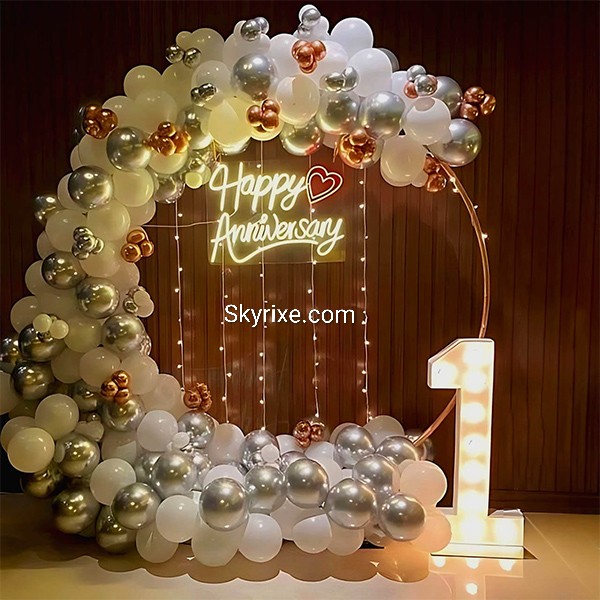
Someone sends over a Pinterest link before every consultation. Nine times out of ten, it's a floor-to-ceiling balloon wall behind a dining table the size of a small ballroom, or a canopy that needs eight feet of clear ceiling to breathe. Then you walk into their actual living room — a sofa on one side, a TV unit on the other, a dining table that also doubles as a study desk, and maybe four feet of genuinely blank wall in the entire flat.
That gap between the reference photo and the real room is the most common conversation we have with clients across Bandra, Andheri, Powai, and Goregaon. It isn't that the photo is wrong. It's that the photo was shot in a space with none of the constraints a real apartment has.
The good news: a small apartment doesn't need less decoration. It needs decoration that's been placed with more thought. That's really the whole idea behind this piece — not another list of balloon styles, but a way of looking at a compact room the way a decorator does before a single balloon goes up.

Why Small Apartments Need a Different Decoration Approach
A large hall forgives mistakes. If a balloon arch is slightly too wide or a garland droops in the middle, there's enough surrounding space that the eye doesn't catch it immediately. A small living room doesn't offer that cushion. Every element is close to every other element — the sofa, the TV, the dining chairs, the decoration — so anything slightly off becomes obvious.
Ceiling height plays into this more than most people expect. Standard Mumbai apartment ceilings sit around nine to ten feet, which sounds like plenty until you're trying to hang a canopy that needs clearance on all sides, not just height. Movement matters too — if guests can't walk from the entrance to the dining table without brushing against a balloon structure, the decoration has become an obstacle rather than a backdrop.
This is really the core mistake we see: the assumption that more balloons automatically means more impact. In a compact room, the opposite is usually true. A dense, wall-to-wall setup in a small space reads as cluttered in person and even more cluttered in photos, where the camera compresses everything into one flat frame. A lighter, more deliberate setup photographs — and feels — considerably bigger.
Think Vertically, Not Horizontally
Floor space in a small apartment is almost always the scarcest resource. Wall space and ceiling space, by comparison, are usually underused. So the first shift in thinking is simple: stop planning across the floor and start planning up the wall.
A narrow balloon garland running vertically from floor to ceiling in a corner uses almost no floor footprint but creates real height and presence. A cluster of balloons anchored at a single point near the ceiling, with a few strands trailing down, does the same thing with even less structure. Even a doorway — often the most overlooked vertical strip in a home — can carry a slim balloon column on either side without blocking anyone's path through it.
Corners deserve more attention than they usually get. A corner installation, where balloons build from floor to roughly eye height and taper off, gives you a strong visual anchor without eating into the room's usable centre. It's one of the few decoration styles that genuinely works better in a small room than a large one — in a big hall, a corner piece can feel lost. In a small flat, it becomes the room's signature.
Choose One Focal Point Instead of Decorating Every Wall
This is the single biggest adjustment we ask clients to make, and it's usually the hardest one to accept at first. The instinct in a small space is to add a little decoration everywhere — a few balloons by the window, a banner over the TV, streamers near the door — because the room feels bare otherwise. It has the opposite effect. Scattered decoration across a small room reads as visual noise, and the eye never settles anywhere.
Pick one wall. Usually it's the one guests face when they walk in, or the one behind the sofa, or the blank stretch beside the TV unit that's never quite known what to do with itself. Put the real decoration there — a garland, a half-arch, a backdrop — and let every other wall stay close to how it already looks.
One well-built focal point does more for a small apartment than five half-hearted touches spread across the room. It gives guests somewhere to look, somewhere to stand for photos, and it makes the rest of the space feel intentionally calm rather than unfinished.
5 Elegant Balloon Decoration Styles That Work in Small Apartments
Each of these solves a specific space problem rather than just being a style choice. Where it works, what it needs, and what to skip — in that order.
1. Minimal Balloon Garland Along One Wall
Where it works: any single wall with at least six to eight feet of relatively clear space — behind a sofa, along a dining wall, or beside a window.
Why it works in a small room: a garland is flexible. It can hug a wall closely, rather than projecting outward the way a full arch does, so it doesn't reduce the usable floor area at all.
Space required: essentially none beyond the wall itself. This is the lowest-footprint option on this list.
What to avoid: don't run the garland floor to ceiling on a wall that's also carrying a wall-mounted TV or a large piece of art — it competes for the same visual attention and both elements lose impact.
2. Corner Balloon Installation
Where it works: an unused corner near the entrance, beside a bookshelf, or flanking a doorway.
Why it works in a small room: it uses a dead zone that most apartments already have. Corners rarely serve a functional purpose, so decorating one doesn't cost you any usable space.
Space required: roughly a two-foot radius at floor level, tapering as it rises.
What to avoid: don't place it in a corner that's also a walking path — check where people naturally move through the room before committing to the spot.
3. Half-Arch Around a Backdrop
Where it works: behind a designated photo spot, ideally against the room's plainest wall.
Why it works in a small room: a full arch needs space on both sides to read as symmetrical. A half-arch — balloons building up one side and along the top — needs space on one side only, which suits an asymmetrical room layout much better.
Space required: about four to five feet of wall width, with a small footprint at the base.
What to avoid: don't centre it on a wall that already has furniture pushed against the middle — build it into the actual empty stretch, even if that means it sits slightly off-centre in the room.
4. Ceiling-Focused Balloon Clusters
Where it works: dining areas, the space above a seating cluster, or directly above where the main celebration moment (cake-cutting, a toast, a reveal) will happen.
Why it works in a small room: it adds visual richness without touching the floor or walls at all, which matters enormously when both are already accounted for by furniture.
Space required: no floor footprint; needs secure ceiling anchor points and roughly a foot of clearance below the cluster for it to read as intentional rather than cramped.
What to avoid: avoid hanging clusters directly above a dining table where they'll interfere with reaching across for food, or directly under a ceiling fan.
5. Compact Photo Corner
Where it works: a two-by-two-foot patch of floor with a plain wall behind it — often the same wall as the main focal point, reused.
Why it works in a small room: it doesn't need to be a separate structure. It can simply be the empty floor space in front of whichever focal wall you've already built, kept deliberately clear.
Space required: enough for two to three people to stand comfortably, roughly six square feet.
What to avoid: don't let the food table or gift pile creep into this spot over the course of the party — it's the one area worth actively protecting once guests start arriving.
How Colour Choices Can Make a Small Room Feel Bigger
Colour does more visual work in a small space than most people give it credit for. A wide, varied palette breaks a room up into segments — the eye keeps stopping to process each new colour block, and that reads as a smaller, busier space. A tighter palette lets the eye move across the room in one continuous sweep, which reads as more open.
Light, neutral tones — ivory, blush, soft sage, champagne — tend to recede visually, so they make walls feel like they're further away rather than closing in. A monochrome approach, where every balloon sits within a few shades of the same colour family, does something similar: it removes the visual seams that separate one decoration element from another.
Two-colour palettes are the safest default for a compact room, and metallic accents (chrome, gold foil) are worth using sparingly rather than as a whole balloon type — a metallic highlight catches light and adds richness without adding another distinct colour block for the eye to process.
Don't Forget the Furniture: Work Around What You Already Have
The instinct to clear the entire living room before decorating is understandable, but it's rarely necessary and it's almost never worth the effort for a home celebration. A sofa, a TV unit, a dining table — these aren't obstacles to remove. They're the shape the room already has, and good decoration works with that shape rather than against it.
A wall-mounted television is one of the most common concerns clients raise, and the honest answer is that it doesn't need to be covered or worked around dramatically — a garland or arch positioned beside it, rather than behind it, usually looks more considered than an attempt to disguise the screen entirely. A sofa backing onto your chosen focal wall isn't a problem either; balloon garlands sit comfortably above the sofa's back cushion line without needing the furniture moved.
Curtains are worth checking before installation day, particularly if the plan involves fairy lights woven behind them — heavier curtain fabric can hide the light source too well and mute the glow you're trying to create. Dining tables that double as everyday furniture (a common setup in smaller flats) are usually fine to leave in place; the decoration builds around them rather than requiring the table to be relocated for the day.
Lighting Matters More in a Small Apartment Than You Think
A small room amplifies whatever light it has, for better or worse. Harsh, direct overhead lighting in a compact space creates shadows that fall close to the decoration itself, because there's so little distance between the light source, the balloons, and the walls. Warm, indirect lighting softens all of that.
Fairy lights woven through a garland or cluster do two things at once in a small room: they add warmth, and they draw the eye upward and outward, which subtly works against the feeling of a cramped space. Natural light, where it's available, is worth planning around rather than fighting — positioning the focal wall to catch afternoon light through a window often does more for how the decoration looks than any additional balloon element would.
The one thing to watch for specifically in small apartments: balloons placed too close to a single lamp or downlight can throw an oversized, distorted shadow onto a nearby wall, which is far more noticeable in a compact room than a large hall. A quick walk-through with the lights on, before guests arrive, catches this in a minute.
How to Make the Decoration Look Bigger in Photos
A phone camera compresses a room the same way a small room already feels compressed in person, so the two problems compound unless you plan for it. A few adjustments make a real difference. Shoot from slightly below eye level rather than straight on — it exaggerates the height of a vertical garland or corner installation and makes the ceiling feel higher than it is.
Keep the foreground empty. If there's a side table, a stray charger cable, or a stack of magazines between the camera and the decoration, it reads as clutter in the photo even if it barely registers in person. Vertical shots, rather than wide horizontal ones, tend to flatter a small room because they crop out the ceiling and floor clutter on either side of the main subject.
And it's worth resisting the urge to fit the entire room into one photo. A tightly framed shot of just the focal wall, with the photo corner's empty space in front of it, almost always looks more spacious and more intentional than a wide shot that captures the sofa, the dining table, and the decoration all competing for attention in a single frame.
Small Apartment Decoration by Occasion
The space-planning principles above stay constant. What changes is how they get applied depending on what's being celebrated.
For a birthday, the focal wall usually carries the personalisation — a name, an age, a banner — and the corner installation or ceiling cluster adds energy without needing extra floor space. For an anniversary, the same footprint works quieter: warmer tones, a smaller and more intimate focal point, often paired with lighting rather than volume of balloons. A baby shower leans on the vertical-garland approach with soft pastels, since the emotional centre of the room is usually the seating area rather than a large backdrop.
A kids' party is the one occasion where a slightly denser focal point earns its keep, since children respond to colour and scale — but the corner-and-ceiling combination still keeps the actual play area clear, which matters more with kids in the room than with any other guest type. A proposal setup almost always works best as a single, carefully lit focal point rather than a full-room transformation — restraint reads as more deliberate, and more romantic, than volume.
What a Professional Decorator Looks at Before Setting Up in a Small Apartment
Before any material goes into the flat, a proper site check covers a specific list of things, and most of it has nothing to do with balloon colours.
• Wall dimensions — the actual clear width and height of the intended focal wall, not an estimate
• Ceiling height and any obstructions — fans, hanging lights, beams
• Furniture position and whether anything genuinely needs to move, versus what the design can work around
• Electrical points — where fairy lights or LED elements can plug in without a trailing cable crossing a walkway
• Access to the building — lift size and availability, since larger structures sometimes need to go up in sections
• Society or building restrictions — some buildings limit what can be attached to walls or doors, worth confirming ahead of time
• Available setup time — a compact space can sometimes take longer to install cleanly than a large hall, because there's less room to work in
• Natural light through the day, and how it will change by the time guests arrive
• Where the photography will actually happen, checked against where the furniture and foot traffic naturally sit
None of this is complicated, but skipping it is exactly how a beautiful design ends up not fitting the room it was meant for.
A Simple Small-Apartment Decoration Planning Checklist
☐ Measure the available wall — width and height, not a guess
☐ Decide the focal point before choosing balloon styles
☐ Move only the furniture that genuinely needs to move
☐ Choose a limited colour palette — two colours plus one metallic accent, at most
☐ Keep the main walking path from entrance to seating clear
☐ Decide in advance where photographs will be taken
☐ Check society or building restrictions on wall or door attachments
☐ Confirm installation timing against lift access and setup duration
How Skyrixe Approaches Small Apartment Decorations
The process starts with the room, not the catalogue. Before any design is proposed, we're trying to understand the actual space — its dimensions, its light, what furniture is staying put, and what the occasion needs to feel like once it's set up.
From there, the focal point gets chosen based on where guests will naturally look and gather, not based on which wall happens to be biggest. Scale gets matched to the room rather than to a reference photo, and the colour palette gets narrowed early, because that decision affects almost everything that follows. Lighting and installation get planned together, since a design that looks right on paper can still fall flat if the room's existing light works against it.
Once the setup is in place, the final check is a walk-through of the room as a guest would experience it — from the door, from the seating area, and through a camera lens — before anyone leaves. A small apartment doesn't leave room for adjusting after the fact, so getting that walk-through right matters more than it would in a larger venue.
FAQ
Can balloon decoration work in a 1BHK apartment?
Yes — a 1BHK often works better with a single strong focal point than a larger flat does, simply because there's less competing wall space to distract from it. The same vertical, one-wall approach described above applies directly.
How many balloons are needed for a small room?
It depends entirely on the style chosen rather than the room's size. A minimal garland along one wall might use far fewer balloons than a corner installation with ceiling clusters, and both can look complete. The right question isn't quantity — it's whether the chosen style matches the available space.
How do I decorate a small living room without making it look crowded?
Limit yourself to one focal wall, keep the colour palette to two tones plus a metallic accent, and leave the walking path and photo area genuinely clear before adding anything else.
What wall is best for balloon decoration?
Usually the wall guests naturally face when they enter, or the plainest wall in the room — one without a window, mirror, or large piece of furniture already competing for attention.
Can balloon decoration work in a rented apartment?
Yes, provided the installation avoids anything that damages paint or walls. Freestanding structures, removable adhesive hooks, and furniture-anchored garlands all work well without requiring permanent fixtures — worth confirming with your building's rules beforehand.
Can I have an elegant balloon setup without a large backdrop?
Yes — a half-arch, a corner installation, or a vertical garland all create a clear focal point without needing a full backdrop wall or a large clear wall space.
What colours work best in a small room?
Light, neutral tones and monochrome palettes tend to make a compact space feel more open. Two colours plus a metallic accent is a reliable, elegant default for most small-apartment setups.
How much space should I leave for guests?
Enough for people to move between the entrance and the main seating or photo area without brushing against the decoration — as a rough guide, keep at least a three-foot walking path clear at all times.
✨ Skyrixe designs balloon decoration for Mumbai apartments of every size — focal-point garlands, corner installations, and full-room setups planned around your actual space. Packages from Rs. 999. Covers Andheri, Bandra, Powai, Goregaon, Thane, and all Mumbai areas. → skyrixe.com/mumbai/birthday-decoration